Yuanting Fan

Logo Researcher, Tencent Youtu Lab

The researcher of Tencent Youtu Lab. Major in Computer Vision; Super-Resolution; Generative Models; Multimodal Large Language Model; Anomaly Detection; Anomaly Generation.


Education
  • Xi'an Jiaotong University
    Xi'an Jiaotong University
    MSE in Software Engineering
    Sep. 2022 - Jul. 2025
  • Chang'an University
    Chang'an University
    B.S. in Software Engineering
    Sep. 2018 - Jul. 2022
Experience
  • Tencent Youtu Lab
    Tencent Youtu Lab
    Researcher
    Jul. 2025 -
Selected Publications (view all )
InstanceSR: Efficient Reconstructing Small Object with Differential Instance-level Super-Resolution

Yuanting Fan, Chengxu Liu, Ruhao Tian, Xueming Qian

IEEE TCSVT2024 2024

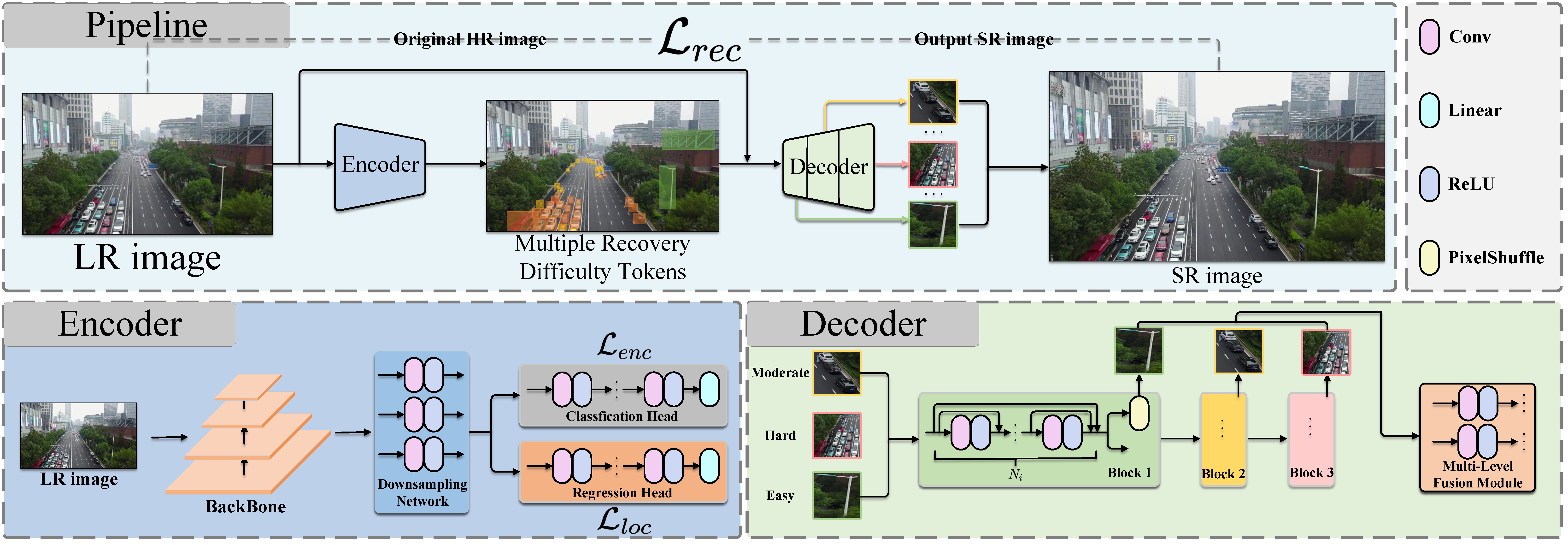
Super-resolution (SR) aims to restore a high-resolution (HR) image from its low-resolution (LR) counterpart. Existing works try to achieve an overall average recovery over all regions to provide better visual quality for human viewing. If we desire to explore the potential that performs super-resolution for machine recognition instead of human viewing, the solution should change accordingly. From this insight, we propose a new SR pipeline, called InstanceSR, which treats each region in the LR image differentially and consumes more resources to focus on the recovery of the foreground region where the instances exist. In particular, InstanceSR consists of an encoder that formulates the LR image into a set of various difficulty tokens according to the instances distribution in each sub-region, and a decoder based on a multi-exit network structure to recover the sub-regions corresponding to various difficulty tokens by consuming different computational resources. Experimental results demonstrate the superiority of the proposed InstanceSR over state-of-the-art models, especially the recovery of regions where instances exist, by extensive quantitative and qualitative evaluations on three widely used benchmarks containing small instances. Besides, the comparisons using SR results on three challenging small object detection benchmarks verify that our InstanceSR can consistently boost the detection accuracy and has great potential for subsequent machine recognition.

InstanceSR: Efficient Reconstructing Small Object with Differential Instance-level Super-Resolution

Yuanting Fan, Chengxu Liu, Ruhao Tian, Xueming Qian

IEEE TCSVT2024 2024

Super-resolution (SR) aims to restore a high-resolution (HR) image from its low-resolution (LR) counterpart. Existing works try to achieve an overall average recovery over all regions to provide better visual quality for human viewing. If we desire to explore the potential that performs super-resolution for machine recognition instead of human viewing, the solution should change accordingly. From this insight, we propose a new SR pipeline, called InstanceSR, which treats each region in the LR image differentially and consumes more resources to focus on the recovery of the foreground region where the instances exist. In particular, InstanceSR consists of an encoder that formulates the LR image into a set of various difficulty tokens according to the instances distribution in each sub-region, and a decoder based on a multi-exit network structure to recover the sub-regions corresponding to various difficulty tokens by consuming different computational resources. Experimental results demonstrate the superiority of the proposed InstanceSR over state-of-the-art models, especially the recovery of regions where instances exist, by extensive quantitative and qualitative evaluations on three widely used benchmarks containing small instances. Besides, the comparisons using SR results on three challenging small object detection benchmarks verify that our InstanceSR can consistently boost the detection accuracy and has great potential for subsequent machine recognition.

AdaDiffSR: Adaptive Region-aware Dynamic Acceleration Diffusion Model for Real-World Image Super-Resolution

Yuanting Fan, Chengxu Liu, Nengzhong Yin, Changlong Gao, Xueming Qian

ECCV2024 2024

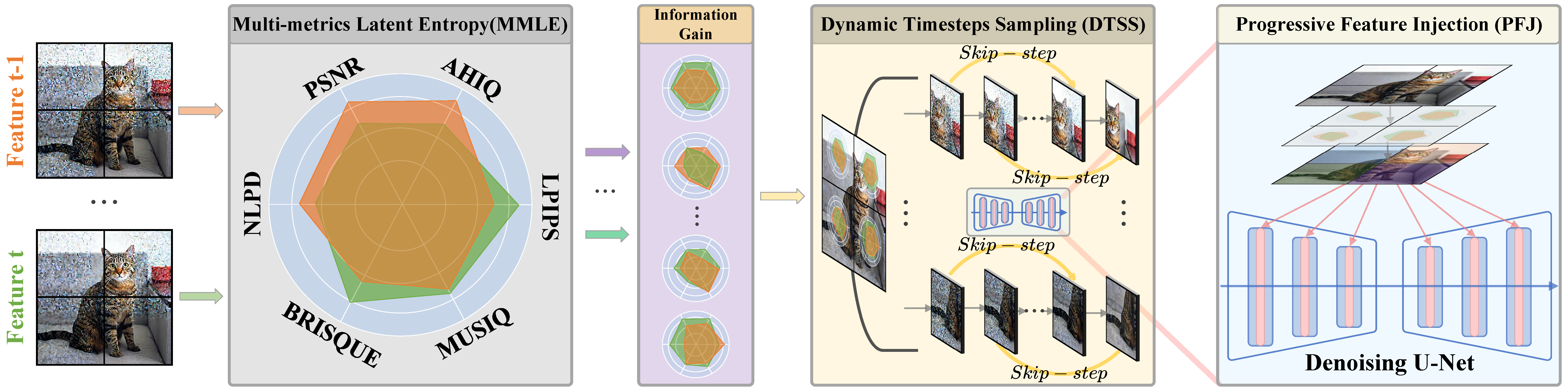
Diffusion models (DMs) have shown promising results on single-image super-resolution and other image-to-image translation tasks. Benefiting from more computational resources and longer inference times, they are able to yield more realistic imagesqueryThis is to inform you that corresponding author has been identified as per the information available in the Copyright form.. Existing DMs-based super-resolution methods try to achieve an overall average recovery over all regions via iterative refinement, ignoring the consideration that different input image regions require different timesteps to reconstruct. In this work, we notice that previous DMs-based super-resolution methods suffer from wasting computational resources to reconstruct invisible details. To further improve the utilization of computational resources, we propose AdaDiffSR, a DMs-based SR pipeline with dynamic timesteps sampling strategy (DTSS). Specifically, by introducing the multi-metrics latent entropy module (MMLE), we can achieve dynamic perception of the latent spatial information gain during the denoising process, thereby guiding the dynamic selection of the timesteps. In addition, we adopt a progressive feature injection module (PFJ), which dynamically injects the original image features into the denoising process based on the current information gain, so as to generate images with both fidelity and realism. Experiments show that our AdaDiffSR achieves comparable performance over current state-of-the-art DMs-based SR methods while consuming less computational resources and inference time on both synthetic and real-world datasets.

AdaDiffSR: Adaptive Region-aware Dynamic Acceleration Diffusion Model for Real-World Image Super-Resolution

Yuanting Fan, Chengxu Liu, Nengzhong Yin, Changlong Gao, Xueming Qian

ECCV2024 2024

Diffusion models (DMs) have shown promising results on single-image super-resolution and other image-to-image translation tasks. Benefiting from more computational resources and longer inference times, they are able to yield more realistic imagesqueryThis is to inform you that corresponding author has been identified as per the information available in the Copyright form.. Existing DMs-based super-resolution methods try to achieve an overall average recovery over all regions via iterative refinement, ignoring the consideration that different input image regions require different timesteps to reconstruct. In this work, we notice that previous DMs-based super-resolution methods suffer from wasting computational resources to reconstruct invisible details. To further improve the utilization of computational resources, we propose AdaDiffSR, a DMs-based SR pipeline with dynamic timesteps sampling strategy (DTSS). Specifically, by introducing the multi-metrics latent entropy module (MMLE), we can achieve dynamic perception of the latent spatial information gain during the denoising process, thereby guiding the dynamic selection of the timesteps. In addition, we adopt a progressive feature injection module (PFJ), which dynamically injects the original image features into the denoising process based on the current information gain, so as to generate images with both fidelity and realism. Experiments show that our AdaDiffSR achieves comparable performance over current state-of-the-art DMs-based SR methods while consuming less computational resources and inference time on both synthetic and real-world datasets.

All publications